Showing posts with label Air. Show all posts

11.01.2010

Research and Environmental Policy Opportunity!

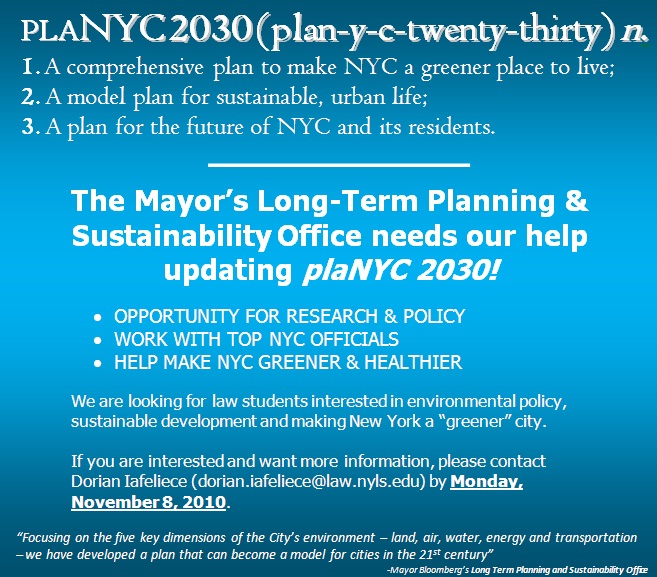
There are 3 things you should know about New York City over the next 25 years: (1) We will be getting BIGGER; (2) our infrastructure will be getting OLDER; and (3) our environment will be AT RISK. PlaNYC 2030 is a comprehensive sustainability plan for New York that addresses each of these challenges.

The Mayor's Long Term Planning and Sustainability Office wants to update PlaNYC 2030 and has reached out to us, the ELS of NYLS, for help.

We are looking for INTERESTED STUDENTS to work with us on this project.

We are still in the planning stage, but anticipate beginning on this project in early January 2011 (with a chance of starting even earlier). Before proceeding we need to gauge student interest, so...

If you ARE INTERESTED in tackling this research project with us and want more information, please contact Dorian Iafeliece (dorian.iafeliece@law.nyls.edu) by Monday, Nov. 8th, 2010. Students interested in sustainable development, green infrastructure and environmental law are encouraged to join us.

You will get an opportunity to work with top New York City Officials on how to make NYC are greener and better city to live in!

10.25.2010

DOT, EPA Propose the Nation’s First Greenhouse Gas and Fuel Efficiency Standards for Trucks and Buses

EPA and DOT logos (2010)
WASHINGTON – The U.S. Environmental Protection Agency (EPA) and the U.S. Department of Transportation (DOT) today announced the first national standards to reduce greenhouse gas (GHG) emissions and improve fuel efficiency of heavy-duty trucks and buses. This comprehensive national program is projected to reduce GHG emissions by about 250 million metric tons and save 500 million barrels of oil over the lives of the vehicles produced within the program’s first five years.

EPA and DOT’s National Highway Traffic Safety Administration (NHTSA) are proposing new standards for three categories of heavy trucks: combination tractors, heavy-duty pickups and vans, and vocational vehicles. The categories were established to address specific challenges for manufacturers in each area. For combination tractors, the agencies are proposing engine and vehicle standards that begin in the 2014 model year and achieve up to a 20 percent reduction in carbon dioxide (CO2) emissions and fuel consumption by 2018 model year.