Carbon Nation, is an optimistic, forward-looking film, exploring potential alternatives to carbon fuel.
"From one-armed Texas cotton farmer Cliff Etheridge’s efforts to pull together an enormous wind farm, to green jobs innovator Van Jones, Peter Byck’s film presents vital solutions to a thorny problem and in the process reveals a thriving tradition of American ingenuity."
The Film Society of Lincoln Center is screening Carbon Nation THIS THURSDAY, February 10 at 6:30pm. BUY YOUR TICKETS NOW!
For more information, see the Film Society's page.
Showing posts with label Carbon Emissions. Show all posts
Showing posts with label Carbon Emissions. Show all posts
2.08.2011
Carbon Nation: A climate change solutions movie [that doesn't even care if you believe in climate change]
11.17.2010
EPA Releases the 2010 Fuel Economy Trends Report

WASHINGTON - For the sixth consecutive year, the U.S. Environmental Protection Agency (EPA) is reporting a decrease in average carbon dioxide (CO2) emissions and a slight increase in the average fuel efficiency for new cars and light duty trucks, according to EPA’s annual report “Light-Duty Automotive Technology, Carbon Dioxide Emissions, and Fuel Economy Trends: 1975 through 2010”.
EPA projects a small improvement in 2010, based on pre-model year sales estimates provided by automakers, to 395 grams of CO2 per mile and 22.5 miles per gallon (mpg), though there is uncertainty in these projections as they were made during the atypical automotive market in 2009. The 2010 final data will be available in next year’s report.
For 2009, the last year EPA has final data from automakers, the average CO2 emissions from new vehicles were 397 grams per mile and the average fuel economy value was 22.4 mpg.
See below for more on this report...
11.01.2010
Research and Environmental Policy Opportunity!
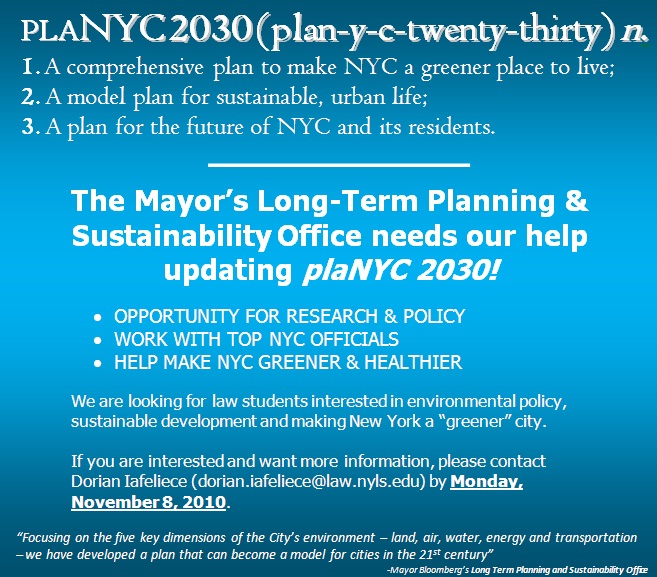
There are 3 things you should know about New York City over the next 25 years: (1) We will be getting BIGGER; (2) our infrastructure will be getting OLDER; and (3) our environment will be AT RISK. PlaNYC 2030 is a comprehensive sustainability plan for New York that addresses each of these challenges.
The Mayor's Long Term Planning and Sustainability Office wants to update PlaNYC 2030 and has reached out to us, the ELS of NYLS, for help.
We are looking for INTERESTED STUDENTS to work with us on this project.
We are still in the planning stage, but anticipate beginning on this project in early January 2011 (with a chance of starting even earlier). Before proceeding we need to gauge student interest, so...
If you ARE INTERESTED in tackling this research project with us and want more information, please contact Dorian Iafeliece (dorian.iafeliece@law.nyls.edu) by Monday, Nov. 8th, 2010. Students interested in sustainable development, green infrastructure and environmental law are encouraged to join us.
You will get an opportunity to work with top New York City Officials on how to make NYC are greener and better city to live in!
10.25.2010
DOT, EPA Propose the Nation’s First Greenhouse Gas and Fuel Efficiency Standards for Trucks and Buses
 |
| EPA and DOT logos (2010) |
WASHINGTON – The U.S. Environmental Protection Agency (EPA) and the U.S. Department of Transportation (DOT) today announced the first national standards to reduce greenhouse gas (GHG) emissions and improve fuel efficiency of heavy-duty trucks and buses. This comprehensive national program is projected to reduce GHG emissions by about 250 million metric tons and save 500 million barrels of oil over the lives of the vehicles produced within the program’s first five years.
10.24.2010
Feds to propose FIRST EVER truck fuel efficiency rules

"Future tractor-trailers, school buses, delivery vans, garbage trucks and heavy-duty pickup trucks must do better at the pump under first-ever fuel efficiency rules coming from the Obama administration."
"The fleet of new cars, pickup trucks and SUVs will need to reach 35.5 miles per gallon by 2016, and the government is developing plans for future vehicle models that could push the standards to 47 mpg to 62 mpg by 2025."Is this good enough?
9.08.2010
Landfilling Plastic Bottles May be Better than Recycling?
 Just when you thought we had it right, this post from Eric Johnson (director of Atlantic Consulting, a Swiss-based strategic consulting company) claims that, in certain circumstances, landfilling plastic water bottles may have a lower carbon-footprint than recycling.
I'm not too sure if I buy into this just yet. I wonder if Thomas Friedman has anything to say about this claim... -JA
4.06.2010
Coke's New Eco-Friendly Bottle Re-Design

For those of you can read French follow this link for more information about the designer and Coca Cola's new approach to the eco-market; http://www.trendsnow.net/2010/04/eco-coke-bottle-design.html
For those of you who don't speak or read french, the above link has links to English explanations of the redesign using images, graphs, and charts.

Do you think this will make a difference in peoples perception of the brand? Do you think that this will actually lower carbon emissions or will the public ignore the "call to recycle"?
Is the shipment method really going to lower the companies emissions or will Coca Cola continue to ship more of its product using the money saved from its "more effective shipping methods" to export more product?
What do you think?
Subscribe to:
Posts (Atom)

 Posts
Posts


