Showing posts with label Water. Show all posts

2.03.2011

EPA: Brooklyn's Gowanus Canal is disgusting!

"EPA’s investigation confirmed the widespread presence of more than a dozen contaminants, including polychlorinated biphenyls (PCBs), polycyclic aromatic hydrocarbons (PAHs) and various metals, including mercury, lead and copper, at high levels in the sediment in the Gowanus Canal."

Why am I not surprised?

The EPA's "Human Health Risk Assessment" also found that people who eat fish and crabs from the Canal are at risk from exposure to PCBs. My question is, who the heck is eating fish from the Gowanus Canal?

As the EPA moves forward with the Draft Feasibility Study, a lot of questions remain, namely: can we really "revitalize" the Gowanus Canal? How long is this going to take? 10, 20, 30 years? How much is this costing the taxpayers? Can the EPA track down the "Potentially Responsible Parties"? And who is ultimately benefiting from the Superfund process?

12.09.2010

Criminal Charges for Brooklyn Businesses, Dumping Raw Sewage

Four individuals and four businesses at a Brooklyn shopping center face criminal charges over dumping raw sewage and restaurant grease into Sheepshead Bay. The charges are punishable with charges of $75k per day and up to three years imprisonment.

12.01.2010

Groups Applaud NY State Assembly for Passing a "Timeout" on Fracking for Natural Gas

Yesterday, the New York State Assembly voted to protect NY's watershed by passing legislation that puts a timeout on hydraulic fracturing for natural gas. By passing this bill, A.11443, the Assembly has taken a stand, and recognizes the potential hazards of fracking activities.


The bill suspends the issuance of permits to hydraulically fracture natural gas wells in New York State until May 15, 2011. 


For more info, check out this EarthJustice Press Release.

11.29.2010

Norfolk, VA Prepares for Rising Sea Levels

The city of Norfolk (Virginia) will not sit around and just wait for sea-levels to rise. Situated just west of the mouth of Cheasapeake Bay, it is bordered on 3 sides by water, and has, thus far, experienced the highest relative increase in sea level on the East Coast (14.5" since 1930).

I sure hope other coastal cities (ahem...NYC...) follow suit. This is not a drill, people!

11.04.2010

The Vacuum from the Sea

Remember that huge Island of garbage in the Pacific Ocean? Well one company is actually doing something about it by taking the adrift plastic and turning it into something usable by consumers.

Enter: the Electrolux Vac from the Sea


To read more about this product click on this link: http://links.everyguyed.com/87aa77433c933d56/?web=35eb38&dst=http%3A//leberpr.com/blog/%3Fp%3D931%23

11.01.2010

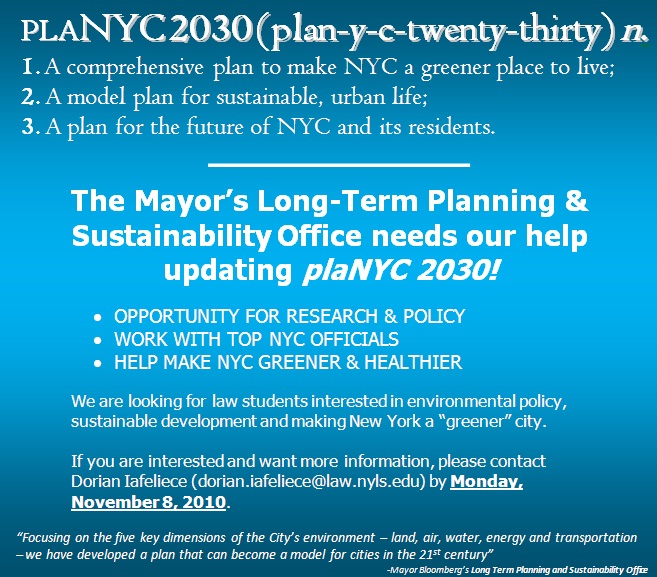
Research and Environmental Policy Opportunity!

There are 3 things you should know about New York City over the next 25 years: (1) We will be getting BIGGER; (2) our infrastructure will be getting OLDER; and (3) our environment will be AT RISK. PlaNYC 2030 is a comprehensive sustainability plan for New York that addresses each of these challenges.

The Mayor's Long Term Planning and Sustainability Office wants to update PlaNYC 2030 and has reached out to us, the ELS of NYLS, for help.

We are looking for INTERESTED STUDENTS to work with us on this project.

We are still in the planning stage, but anticipate beginning on this project in early January 2011 (with a chance of starting even earlier). Before proceeding we need to gauge student interest, so...

If you ARE INTERESTED in tackling this research project with us and want more information, please contact Dorian Iafeliece (dorian.iafeliece@law.nyls.edu) by Monday, Nov. 8th, 2010. Students interested in sustainable development, green infrastructure and environmental law are encouraged to join us.

You will get an opportunity to work with top New York City Officials on how to make NYC are greener and better city to live in!

10.25.2010

Searching For Science In Marcellus Shale Decisions (Law360)

-Image: Geology.com

Law360, New York (October 20, 2010) -- Along with lower energy costs and new jobs, investment in the development of natural gas resources in the Marcellus Shale formation in Pennsylvania has brought claims of groundwater contamination and litigation to the commonwealth. Marcellus Shale development has also precipitated increased scrutiny by federal and state lawmakers and regulators.
Critical and scientific evaluation of reports and other information concerning the potential link between Marcellus Shale production activities and environmental problems is essential to reasoned decisions in the courtroom and in setting public policy for this industry.

10.24.2010

DRBC Again Delays Rules Covering Natural Gas Drilling


The Delaware River Basin Commission is again delaying the release of rules covering the drilling of natural gas within the watershed.
In a statement, the commission announced that the proposed regulations, which were to be unveiled in September and then were delayed until mid-October, now won't come for at least another month. The commission said the delay was to give staffers time to ensure that it minimizes bureaucratic overlap with other regulators.
"The commissioners are working with staff to continue refining the draft regulations to ensure protection of basin waters while minimizing regulatory duplication," the statement said. "The draft regulations will likely be published in November or December 2010, and will be accompanied by a public rulemaking process. This process will entail two public hearings and a written comment period."
The Delaware Riverkeeper Network, which opposes drilling, urged supporters to lobby against releasing the proposed regulations until a federal study is completed. "This federally funded comprehensive study must be done first and then the information learned be used to inform the regulations that the DRBC will adopt regarding gas development in the Delaware River Watershed," said Riverkeeper Maya van Rossum in a statement. "This is essential to [prevent] … pollution and degradation to the Delaware River and the water supply for more than 15 million people."

10.21.2010

Extreme Droughts Taking Toll on South, Midwest

"Parts of Alabama, Louisiana, Arkansas, Mississippi, Tennessee, Missouri, Kentucky, Florida and southern Indiana are suffering 'extreme drought,' according to data expected to be released by the [National Drought Mitigation Center] Thursday."

"Climatologists say the dry weather likely will continue at least until spring, raising the possibility of prolonged drought in some areas next summer."

READ THE REST OF THE WSJ ARTICLE


BETTER YET, READ THE USER COMMENTSThe first comment is from a "climate change denier", who is using 3 straight days of rain as his sign that climate change is a hoax. 


I thought we were past that...

10.15.2010

NYC Mayor and DEP Commissioner Announce New Green Infrastructure to Reduce Sewer Overflows, Improve Quality of City Waterways and Save the City $2.4 Billion

"Mayor Michael R. Bloomberg and Environmental Protection Commissioner Cas Holloway unveiled a new plan to utilize “green infrastructure” to improve the quality of waterways around New York City by capturing and retaining stormwater to reduce sewer overflows."


"The new plan, called NYC Green Infrastructure, will replace the existing approach for sewer overflow control, which relies solely on traditional investments like holding tanks and tunnels, with a mix of green infrastructure and cost-effective traditional infrastructure that will reduce sewer overflows into waterways by 40 percent by 2030 by capturing more stormwater." 


CLICK HERE to read the rest of the Mayor's Press Release.

9.08.2010

Landfilling Plastic Bottles May be Better than Recycling?

Just when you thought we had it right, this post from Eric Johnson (director of Atlantic Consulting, a Swiss-based strategic consulting company) claims that, in certain circumstances, landfilling plastic water bottles may have a lower carbon-footprint than recycling.

I'm not too sure if I buy into this just yet. I wonder if Thomas Friedman has anything to say about this claim... -JA

4.24.2010

No Drilling in NYC Watershed, Good News?


The New York State Department of Environmental Conservation announced yesterday that the Supplemental Generic Environmental Impact Statement for natural gas drilling currently under review will not apply to watersheds that supply unfiltered drinking water.  For now, that means a de facto moratorium on drilling in the New York City watershed.

4.20.2010

Top Ten Earth Day Actions: #10 Shower for Two.

4.19.2010

Tell NY to Wait!

The EPA recently announced that it was launching a study into the effects of hydraulic fracturing on human health and the environment.  New York's own Department of Environmental Conservation is considering similar issues, following the close of the public comment period on their Generic Environmental Impact Statement in December.

Fracking is the process of drilling horizontally into deep layers of rock to create fissures, then pouring millions of gallons of chemical-laced water into the rock formations to soften them.

Gas companies can then suck out the gas, compress it, and transport it around the nation. But when the gas comes up, so does a large part of the water-called flowback. It is not only laden with the lubricating chemicals that the gas company added but also elements like radium, which naturally occur in the rock.

Several New York state legislators have introduced a measure that would put all hydraulic fracturing on hold until the EPA study is complete.  Tell your legislators and Governor Paterson to support the moratorium on fracking until the EPA study is completed--or tell us why you think they shouldn't.

4.02.2010

EPA Gets Tough. New Water Standards Coming Soon

The "6-Year Review" is a good provision. It forces the Agency to monitor and set new goals for improving our national groundwater standards.

3.05.2010

Siberian permafrost leaking methane

Methane is a greenhouse gas thirty times more potent than carbon dioxide.  Climate change is warming the arctic region and destabilizing the subsea Siberian permafrost that has held back massive methane deposits.

"The amount of methane currently coming out of the East Siberian Arctic Shelf is comparable to the amount coming out of the entire world’s oceans. Subsea permafrost is losing its ability to be an impermeable cap."
See the Mother Jones post.

3.02.2010

You can't live without clean water.


Regulatory controls over pollution in American waterways are slipping.  Follow the NYTimes series here, and read our quick recap below.
The court rulings causing these problems focused on language in the Clean Water Act that limited it to “the discharge of pollutants into the navigable waters” of the United States. For decades, “navigable waters” was broadly interpreted by regulators to include many large wetlands and streams that connected to major rivers.
But the two decisions suggested that waterways that are entirely within one state, creeks that sometimes go dry, and lakes unconnected to larger water systems may not be “navigable waters” and are therefore not covered by the act — even though pollution from such waterways can make its way into sources of drinking water.